Monday, August 8, 2016

Tuesday, August 2, 2016
The Promises God Keeps

“…Abraham grew strong
in his faith as he gave glory to God, being fully convinced that God was able
to do what he had promised” (Romans 4:20-21).
While inspiring our faith, this passage also exposes a
couple of issues at the heart of our doubts and struggles. The first is
somewhat obvious: We are not convinced God is able to do what God has promised.
But the second issue is subtler: We don’t know what it is God has promised.
It’s hard to believe God—or anyone—keeps his promises when we don’t know what
the promises are.
In Abraham’s case it was Sarah’s miraculous conception and
the birth of Isaac, the “son of promise.” Abraham believed this promise of God
through years of waiting and serious doubting, and despite the odds and circumstances.
But much larger even than Isaac, God’s promise was the covenantal relationship.
Abraham had to believe God’s promise to be God—to be his God and the God of those he loved, from generation to
generation.
I don’t know how much or often God makes specific promises
to us on the order of miraculous conceptions. Rarely, I suppose. He does
promise in Jesus to care for us and to provide for our needs. And we see this
in the natural world (why must it be considered any less miraculous?) as, every
moment, babies are conceived and bread comes forth from the earth and water is
transformed into the fruit of the vine. But the daily miracle of our existence
in Christ is God’s promise to be “with you always.” And he seals that
promise—through death, resurrection, and ascension—with the indwelling of the
Holy Spirit. This is the angle from which we are to approach all those more
specific promises we hope will come to pass.
Friday, April 1, 2016
Easter and the Mystery of the Missing Lord

I (probably like
you) love the celebration of Easter—the brightness, the triumphant music, the
happy people. But the first Easter was nothing like that. The first Easter was
a mystery—The Mystery of the Missing Lord. John tells us it’s so early that it’s
still dark outside. Darkness and blindness in John’s Gospel always represent
confusion and unbelief. That is certainly more the tone than triumph. Mary Magdalene comes to the tomb to attend to Jesus’s corpse--to make sure it
decomposes with dignity--and maybe to say goodbye.
She is shocked
to find the stone rolled away from the tomb. Her Lord is missing, likely taken
by officials or some twisted activists so they can desecrate his body. Mary rushes and tells
Peter and John, “They have taken the Lord and we don’t know where they’ve put
him!” The guys run to the tomb with Mary following. Surely they’ll have some
answers and ideas—they’re men, after all. But, no. They get there and examine
the empty tomb, scratch their beards, and return home to hide. And they leave
Mary standing there.
The sky has
lightened to a soft gray-blue. Mary begins to think of her life before Jesus.
She was completely possessed, immersed in a life of sin—no love, no God. And
then she met Jesus and everything changed. She found God. She found love and
wholeness. She found a family, and she found herself and her purpose. But now
it’s all gone—he’s gone. Utterly overwhelmed, Mary weeps. She stoops down to
look into the tomb. She can see two figures dressed in bright white sitting
where Jesus’s body had been. They ask Mary why she’s weeping. Now for the
second time, Mary shares her mysterious and tragic news, “They’ve taken my Lord
and I don’t know where they’ve put his body.” Maybe these official-looking
people can help.
The sky begins
to lighten more as bands of deep pink and orange stretch overhead and the first
couple of birds begin to sing. Out of her teary periphery, Mary sees someone.
It’s the gardener—surely he knows something. (Hint: It’s really Jesus.
Let’s watch what happens.) He asks why she's crying. And as a bit of a joke, he
asks whom she's looking for. Now Mary doesn’t simply lament her Lord’s missing
body. Instead, she actually accuses the unrecognized Jesus: “Sir, if you’ve
done something with the body that was here, please have the decency to tell me
where it is and I’ll attend to it.” But Jesus simply says her name—“Mary!”—and
that’s when she knows. “Teacher!” she calls, now weeping tears of joy. The
first rays of the sun shoot above the hilltops and illuminate the garden. The
risen Lord commissions Mary Magdalene to go and tell the others that he has
been raised and will be ascending to the place of authority over heaven and
earth. She runs to the others and shouts the good news, “I have seen the Lord!”
The Mystery of the Missing Lord is solved. And now begins The Mystery of the
Risen Lord. What happens next? What do we do now that Jesus is risen? That’s
another story...billions of other stories, really.
The Mystery of
the Missing Lord is solved for Mary and the disciples, but what about for us?
For many of us the Lord is still missing. We think Jesus’s resurrection means
Jesus is God and we go to heaven when we die. While those things are true, they
have little to do with Easter. What Jesus’s resurrection means is that Jesus is
Lord and heaven comes to us…now. Put another way, Jesus’s
resurrection means Jesus’s way is right—that Jesus’s way of mercy, justice,
peace, forgiveness, and love is God’s way for us and for the world—and that
Jesus is alive to lead us and the world in that way.
That old title, “lord,” means “someone having power,
authority, or influence.” Mary Magdalene and the others are excited, not only
because their friend who was dead is now alive, but because their Lord is still
with them to exercise his power and authority in their lives and in the world.
But for far too many of us so-called Christians, the Lord is still missing. We
give very little thought (much less action) to Jesus's power and authority in
our day-to-day lives, in our long-term goals, or in our worldview. He might as
well still be dead. What difference does it make?
And all of this—your wholeness and the world’s wholeness—begins only when you and I and the two billion other Christians celebrating Easter this season stand up and follow him—no matter what—in his way of mercy, justice, peace, forgiveness, and love. It begins when we can honestly say, with our words but especially with our lives, “I have seen the Lord! He’s alive! My life is his. The world is his.” Then the world will know the Lord is not missing. They’ll find him in us. They'll see him in you.
Friday, March 25, 2016
Behold the Man
I always feel a deep sense of shame when I read the Passion
stories, like I’ve seen something I shouldn’t have—something obscene. The image
of the bloody, beaten Jesus standing in a purple robe with a crown of thorns
before the hissing crowd, sarcastically presented by Pilate, “Here is the man!”
“Drink this in,” Pilate seems to say. “Does this make you
happy?” It’s what John seems to say with the whole narrative, right up to Jesus
on the cross, bloody head bowed in death. “Here is the man. Look at him. Is
this what you want? Because this is what we do—to each other…to God. This is
where this road of sin leads. And he walked it for you and for me. Behold the
man.” And then Joseph of Arimathea and Nicodemus take his lifeless body off the
cross and wrap it and lay it in the tomb. Show’s over. Think about it for a
while.
And so I think about it and I’m ashamed. Shame is rarely a
good idea, almost never a good way of teaching a lesson or leading someone to truth.
But in this case it seems appropriate. Anyway, it seems unavoidable. I’m sorry
we did this to God’s Son. I’m sorry we do this to countless sons and daughters
every day. I’m sorry that this had to be done for me. And I’m especially sorry
that I continue to walk this dead-end path all too often. I’m sorry.
And I’m thankful. The shame gives way to gratitude if I let it—gratitude that I don’t have to live in shame. The cross isn’t merely our shame—it is also our salvation from shame. We didn’t only do this to God. He went through this for us. “For our sake he made him to be sin who knew no sin, so that in him we might become the righteousness of God” (2Cor. 5:21). Behold the man.
And I’m thankful. The shame gives way to gratitude if I let it—gratitude that I don’t have to live in shame. The cross isn’t merely our shame—it is also our salvation from shame. We didn’t only do this to God. He went through this for us. “For our sake he made him to be sin who knew no sin, so that in him we might become the righteousness of God” (2Cor. 5:21). Behold the man.
Tuesday, February 16, 2016
Why God Throws a Party
In his book The Return
of the Prodigal Son, Henri Nouwen makes this observation about Jesus’
parables in Luke 10, featuring the shepherd looking for his lost sheep, the
woman looking for her lost coin, and the father eagerly awaiting the return of
his lost son—each of whom represents God: “God rejoices. Not because the
problems of the world have been solved, not because all human pain and
suffering have come to an end, nor because thousands of people have been
converted and are now praising him for his goodness. No, God rejoices because one of his children who was lost has
been found. What I am called to is to enter into that joy.”
We miss that joy, says Nouwen, because it is small, hidden,
and inconspicuous. The pressure is constant, and only stronger since Nouwen
wrote this in the 1990s, to only find joy in the grand, impressive, and showy.
Even in matters of faith, it is easy to see God and find joy only in big,
miraculous gestures of healing, conversion, worship, etc. But the understanding
of joy I’ve come to at least—that joy is delight and deep contentment in the world and
in ourselves because God is present in both—would say otherwise.
It is God’s presence that brings joy, not the presence of any dazzling spectacle. Sure, the spectacular
might point to God’s presence. But so can the unspectacular, the quiet, the simple—sometimes
even more so, for those who have eyes to see and ears to hear. And that’s what
it comes to: attentiveness.
Wednesday, January 27, 2016
On Sowers and Batting Averages
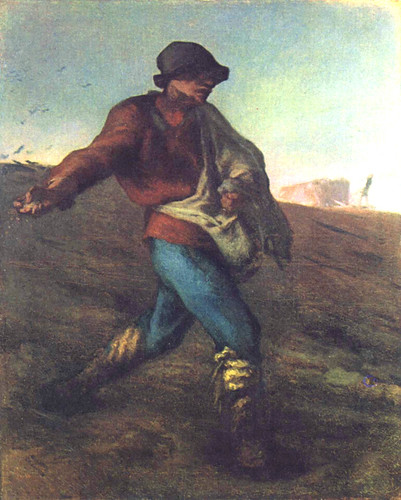 |
| The Sower by Jean-Francois Millet, 1850 |
Jesus’ parable of the sower (Mk. 4:1-20) describes a
.250-hitter who, nevertheless, has a strong RBI total* (to mix metaphors).
He only hits good soil one out of four times—the other three seem to be a miss.
But each hit yields strong results, producing abundant fruit. From the outset
Jesus is describing what would typically be considered failure three out of
four times. Satan, rootlessness, and worldly cares seem to win the day. That’s
the half-empty (or three-fourths empty) way of looking at the glass.
On the other hand, there are at least a couple of things
that make this “failure” a true success. First, the sower. The sower is
faithfully doing what he should do, indiscriminately scattering seed—perhaps generously scattering seed would be more
appropriate. As Wayne Gretzky said (to add another metaphor), “You miss 100% of
the shots you don’t take.” So the sower is taking shots, not knowing where he
might find receptive soil, but sowing nonetheless.
And that’s the other successful aspect of Jesus’ image: the
healthy soil. The seed that finds healthy soil yields fruit in abundance,
including enough seed for much more sowing by other sowers. The fruitfulness becomes exponential.
The harvest is greater than the sower’s meager average. He only connects one
out of four times, but each hit advances others. The harvest doesn’t depend on
the sower. One sows, another waters, but God makes it grow (see 1Cor. 3:5-9).
Jesus seems completely confident in the slow, subtle, seemingly small
advancement of God’s kingdom. And Jesus seems confident in the shared, communal work of God's kingdom. It isn’t about Paul, Apollos, or you or me.
But two things do depend on the sower. One, s/he must sow.
That’s success for the sower—not how much seed finds good soil or even how much
grain is produced, 30- or 60- or 100-fold. Just faithfully sowing—that’s
success. And two, the sower must keep his/her own soil healthy. The word in the
sower’s soul can also be robbed, withered, or choked, and end up fruitless. And one
of the surest ways for this to happen is for the sower to start worrying about
his/her average. To paraphrase Nike: JUST SOW IT!
*Admittedly, the value of such a player in baseball is debatable, but serves the point here.
Tuesday, January 26, 2016
Chosen Instrument
 |
| Jimi Hendrix, Monterey Pop Festival, 1967 Photo by Jim Marshall |
Recently I was conversing with Jesus about the calling of
Saul (Paul) of Tarsus. After Paul’s conversion experience on the Damascus Road,
Jesus instructs an understandably cautious Ananias, “Go! This man is my chosen
instrument to proclaim my name to the Gentiles…” (Acts 9:15). I confessed to
Jesus that I’d like to be his “chosen instrument” for something (despite the
fact that Jesus’ next line about Paul is, “I will show him how much he must suffer for my
name”!). I wondered about the nature of a calling. Are we indeed called to
something specific? And, if so, can we resist and/or miss our calling? But mostly I just wanted to be Jesus' chosen instrument for something.
After sitting in silence with Jesus, his response emerged:
“You are my chosen instrument to be Robert.”
Monday, October 26, 2015
Insiders and Outsiders
“To you has been given
the secret of the kingdom of God, but for those outside, everything comes in
parables…” –Mark 4:11
The way of the kingdom is subtle, small, and unpredictable.
It grows in hidden and wild ways (Mk. 4). It is mysterious—to the extent that
it often can’t be perceived or, at least, understood except by those on “the
inside.” It is divinely revealed, so the “insiders’ are not some elite class or
gnostic possessors of secret wisdom. The insiders are those who go with Jesus
into the inner room of contemplation, those who seek the deeper ways of the
kingdom. No one is restricted from coming. But only a few choose to come
“inside.”
Those who go inside with Jesus, however, those who push
beyond merely hearing the kingdom parables
into living the kingdom parables,
they are the good soil that bears fruit. They are the lamps on stands bringing
illumination. They are harvesters perceiving and urgently reaping the kingdom’s
fruitfulness. They are the birds of the air making their nests in the kingdom’s
comforting shade.
Those “outside” are welcome to the parables. The parables are vessels of God’s
grace revealing to them the good news of the kingdom. And surely many of these "outsiders" come to understand that there is something bigger, that it is something like God’s reign, and
that they can be part of it.
But that’s often the extent, the limit of the revelation. It’s enough for
many…for most, perhaps. Too many, though, remain distracted rocky soil. The
message never takes root. The lamp’s illumination remains hidden. The kingdom’s
crops are passed by with a shrug on the way to more dazzling worldly
attractions. The trying heat of the sun is simply endured. For what relief
could be found in such a small, scraggly, wild shrub?
Monday, October 19, 2015
With Jesus By the Sea
“That same day Jesus
went out of the house and sat beside the sea.”
-Matthew 13:1
There’s something about this picture that is striking. It is
the Creator of the universe, the one who made the sea, sitting beside it,
perhaps contemplating its beauty as he seeks a moment of silent retreat.
But also, it’s just so ordinary. I have walked out of a
house (or hotel) and sat beside the sea. I have sat and pondered the power,
majesty, and mystery of the universe and its Lord and Creator, illustrated in
the power, majesty, and mystery of the sea. I have retreated to the seaside
seeking solitude and silence.
I am in awe of how profound Jesus is, so exalted as the
Creator of all—such power, majesty, and mystery embodied in this most holy one.
I am in awe that he gathers crowds (usually unsolicited) and takes time to
teach them the mysteries of the revelation of God and God’s kingdom, doing so
in parables that they can understand and often using images drawn from his own
creation.
Subscribe to:
Posts (Atom)
NEW BOOK--An Untold Story: Heroism, Mysticism, and the Quest for the True Self
"There is no greater agony than bearing an untold story inside you." ~ Maya Angelou, I Know Why the Caged Bird Sings About the Boo...

-
Rolling Stone magazine's latest cover story features the all-time greatest singers. Ballots were sent to scores of musicians, pro...
-
Regarding the previous post "Music on Mars," I want to begin a discussion on the power of music in worship. I am amazed at the pow...

